

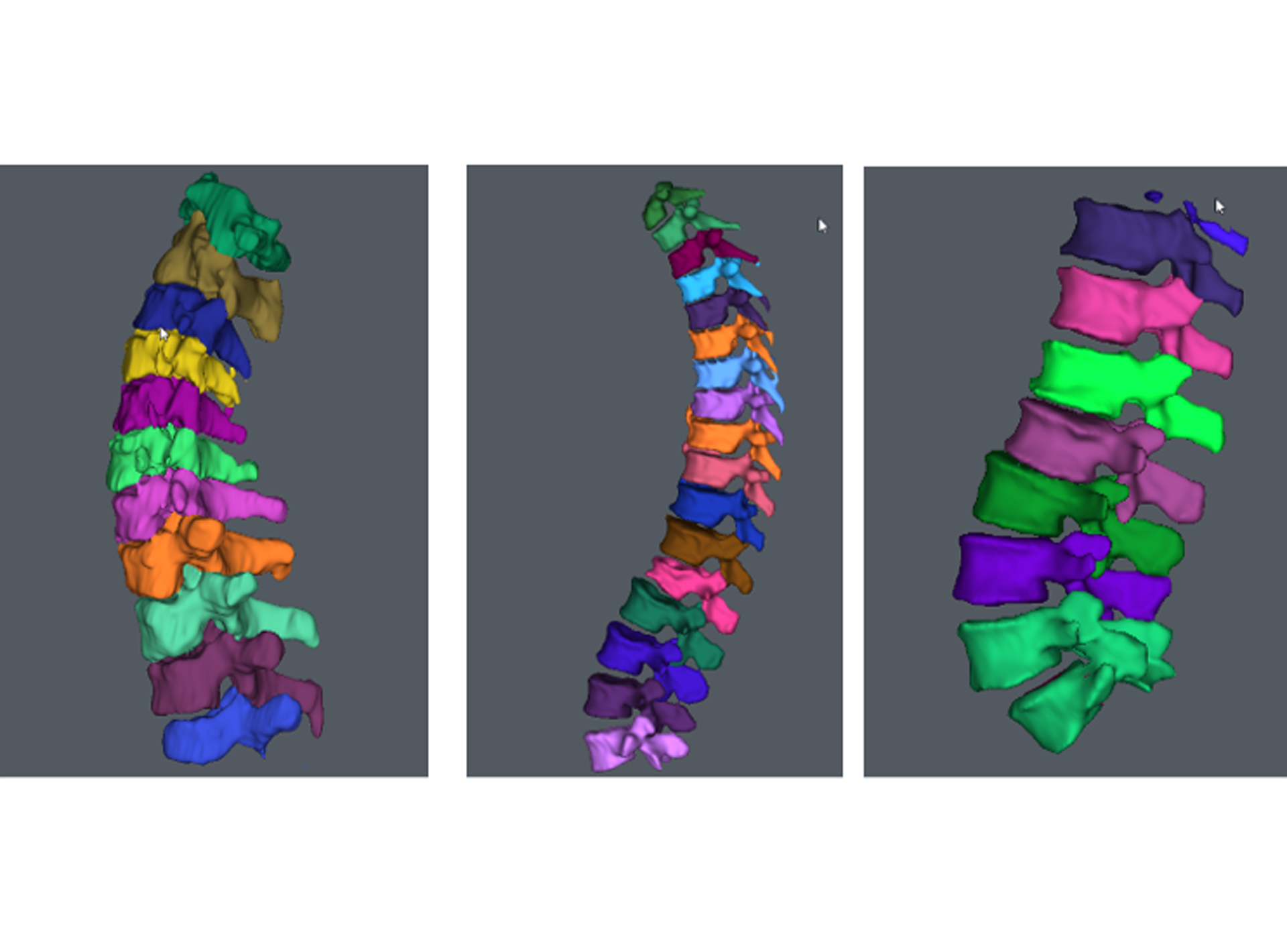
 The new technology, based on Artificial Intelligence (AI) algorithms, can produce imaging of spinal segments within two minutes with an accuracy rate of 95%.
CSIRO’s Data61 alongside the Australian medical imaging company Singular Health have developed a new automated segmentation and labelling technology that has the potential to help medical professionals plan their surgeries and design custom implants.
The technology is designed to work in conjunction with the Singular Health’s MedVR & 3DicomViewer software to produce a manipulable 3D image of the spine and individual vertebrae, all within minutes.
“Manual segmentation is a hugely labour-intensive process, however, by automating it using AI, users will not only save time and energy, but ensure a high degree of segmentation and localisation accuracy,” explains Data61 research lead, Dr Dadong Wang in a press release (PR).
“Radiologists and surgeons will now only have to make small mark-ups and validate the software’s results,” says Dr Guan Tay, Executive Director of Innovation at Singular Health, in the same PR.
“This semi-automated segmentation process will allow surgeons and radiologists to edit the output and ensure 100% compliance with their interpretation of the image whilst still saving vast amounts of processing time,” he added.
About the new tech
According to CSIRO’s announcement, the new technology was designed after testing several different AI models and pre-and-post processing techniques to analyse 200 CT scans of labelled data.
“The AI was developed by adapting deep learning based instance segmentation approaches such as nnU-Net, SC-Net, and 3D Dense-U-Net,” Dr Wang said.
“The models were trained using a public dataset called VerSe’2020, which included 100 CT scans of spines collected from people of different age and gender. The trained models were then tested on another 100 CT scans to generate segmented labels of spine, individual vertebrae, spatial location and identification of each vertebra,” he added.
The new AI-based technology is currently being offered to hospitals, individual clinicians, schools and universities, and it requires the use of Singular Health’s MedVR software.
The development of this new technology was made possible through the support of CSIRO Kick–Start program, which provides funding and support to innovative Australian start-ups and small businesses. Through this program, successful applicants have access to CSIRO’s research and development (R&D) expertise and capabilities.